
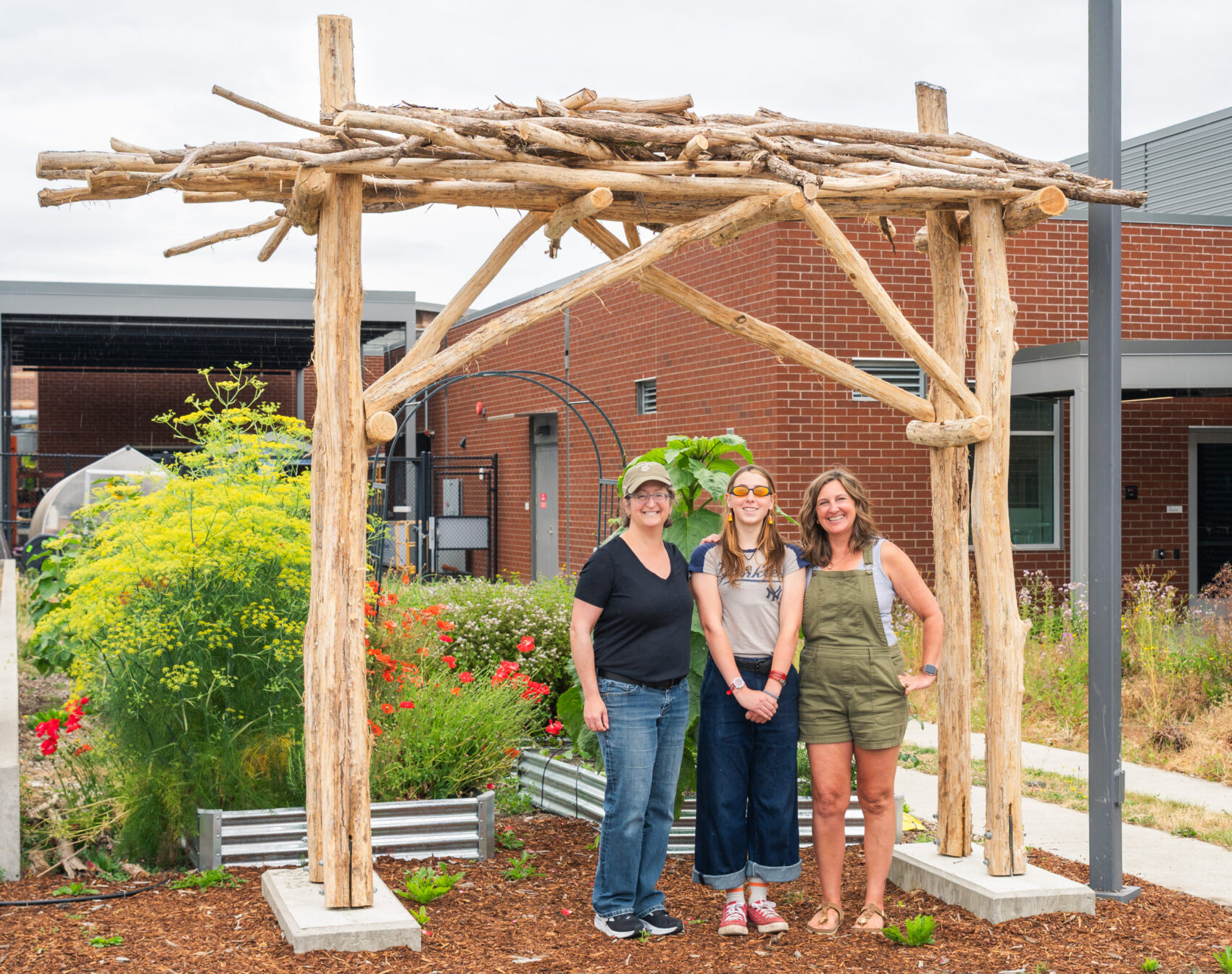
It took an island to create the new welcoming gate for Bainbridge High School’s culinary garden. The “Osprey Arbor” that now graces the garden grew from the efforts of a large network of people and organizations, including BARN.
The story begins during pandemic days when a group of students decided to bring life back to the largely abandoned campus by creating pollinator and culinary gardens. A BHS Garden Club was formed, with BHS teachers Megan Carson and Meloni Courtway jumping in to support the new club.
Funding and support for the gardens came from a National Wildlife Foundation grant obtained by Deb Rudnick of the Bainbridge Island Watershed Council, which is an initiative of Sustainable Bainbridge. Additional funding came from the Rotary Club and Eagle Harbor Congregational Church.
Fast forward to 2026, and the culinary garden is in place and thriving. Local farmer Brian MacWhorter, founder of the local non-profit Butler Green Farm School, was asked to visit the garden and give advice about what vegetables to plant. He shared his knowledge and suggested the garden would be much more impactful if it included a welcoming structure.
That’s when the BARN connection was made. At Rudnick’s suggestion, the club reached out to the BARN Woodworking Studio for help. Mike Rehder, the woodshop’s community service coordinator, agreed to take it on. He made the connection to some black locust trees, an invasive species that the Bainbridge Island Land Trust wanted to remove from one of their properties. Locust happens to be a durable wood for outdoor projects, so a match was made. The trees were harvested with help from David Kotz, who provided guidance on chainsaw operation and then transported the logs to BARN. Kirk Robinson, Wayne Chang, Roz Estime, Paul Webber, Pete deNormandie and David Bobiak all helped to harvest the wood. The logs were peeled with the help of BHS Garden Club members.
In May and June of this year, Rehder began building the structure. First came the foundation. Al Miller from the BARN Metal Fabrication Studio welded beautiful rebar forms for the concrete footings. The concrete was poured with the help of Garden Club members and teachers, and a cement mixer from Deb Rudnick’s landscaper.
From there the structure began to take shape. Rehder thought of the many osprey nests around Bainbridge Island. The gateway is topped by a network of branches inspired by these iconic nests.
“This gate is symbolic of our community and provides a physical foundation for the garden and all of the people who made it possible,” said Jasper Gustafson, BHS Garden Club president. She helped peel the logs and pour the concrete. Now every time she enters the garden, she passes through the arbor created by her community.


Follow Us