
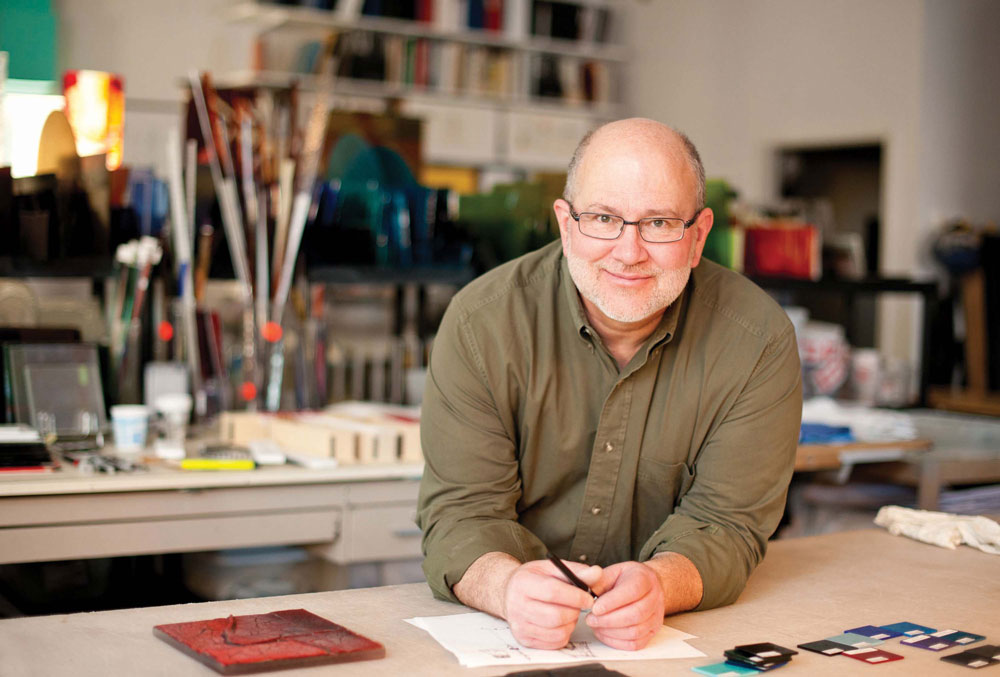
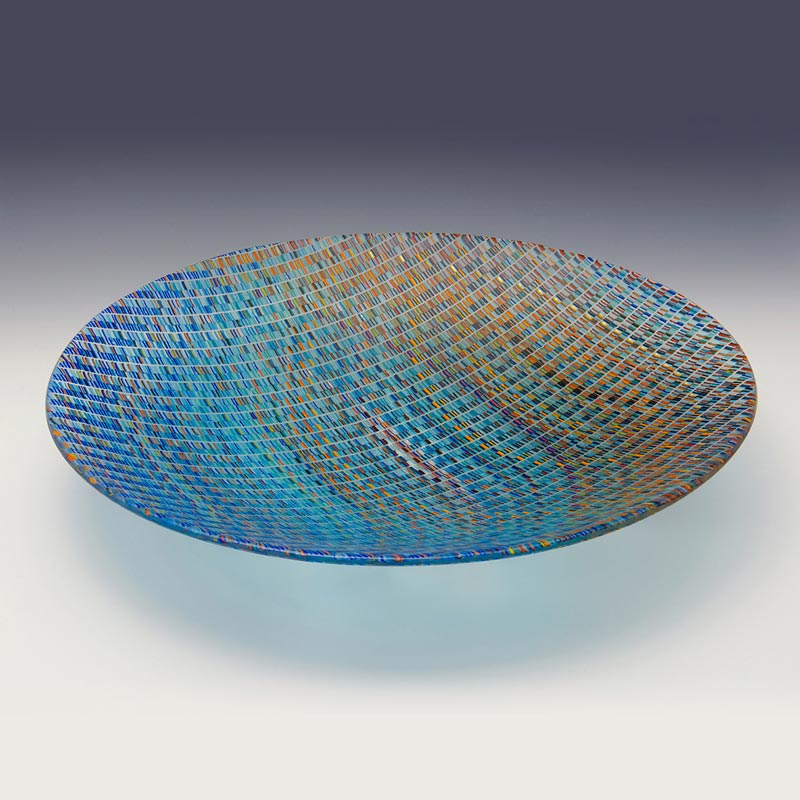
Growing up on a farm in Eastern Idaho, young Richard Parrish was mesmerized by harvested grain fields, their parallel rows marching across the landscape in rhythmic precision. Decades later, Parrish transformed those agricultural memories into works that resemble woven fabric but are actually composed of thousands of precisely cut glass stringers. His Tapestry series—now so synonymous with his name that Bullseye Glass created a 90-minute Master Class Video featuring his step-by-step process—balances mathematical precision with organic feeling, technical mastery with visual poetry.
This spring, Parrish brings over two decades of expertise to BARN for an intensive five-day workshop during Handwork Week 2026.
“As an artist and an architect, I find inspiration in both the natural and the human-made environments. My work investigates the intersections and collisions between the natural landscape and the human impositions on that landscape.”
The Architect Turned Artist
Parrish’s path to glass started far from the studio. He holds a Master of Architecture degree from Cranbrook Academy of Art in Bloomfield Hills, Michigan, and taught architecture and design at the University of Michigan and Montana State University. But architecture, for all its creative possibilities, operates within practical constraints. Buildings must stand up, keep out the weather, satisfy codes, and clients.
In 2001, Parrish made the leap to full-time studio practice. “It’s really important to me to be both a maker and a teacher,” he explained. That dual commitment to making and teaching has shaped a practice that spans continents while remaining deeply rooted in place.
The architectural training never left him. The attention to structure, proportion, and how elements relate within a composition gives his glass work a sophistication that distinguishes it from purely intuitive approaches. He sees patterns everywhere—in aerial photographs, topographical maps, the rhythm of irrigation lines across fields.
From Fields to Fusio Studio
Operating from his Fusio Studio in Bozeman, Montana, Parrish creates three distinct bodies of work: commissioned installations, the decorative Tapestry pieces that established his reputation, and his Mapping series—large, hanging wall panels that suggest landscapes and aerial views.
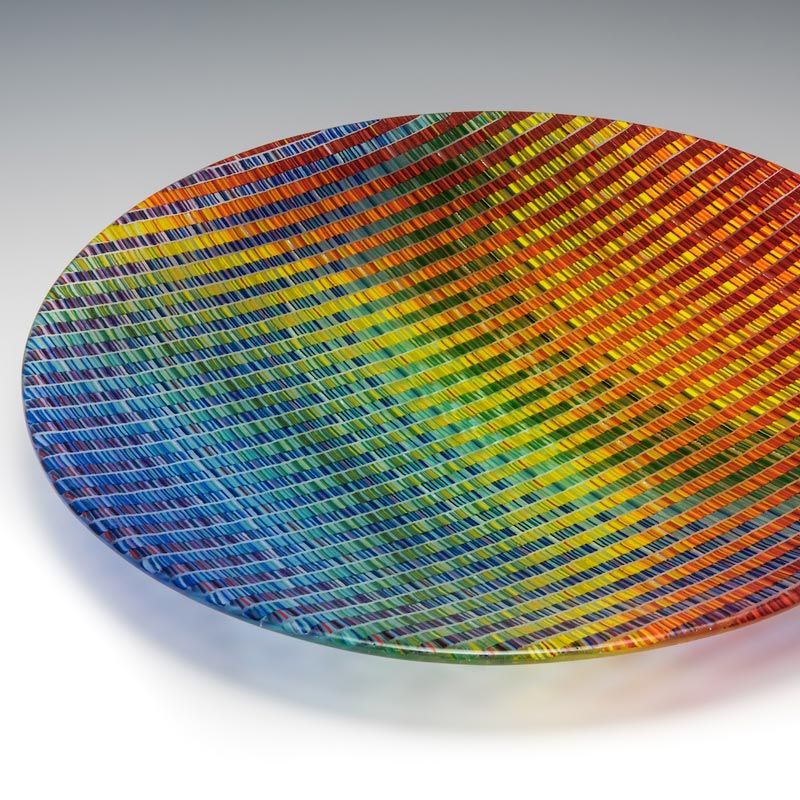
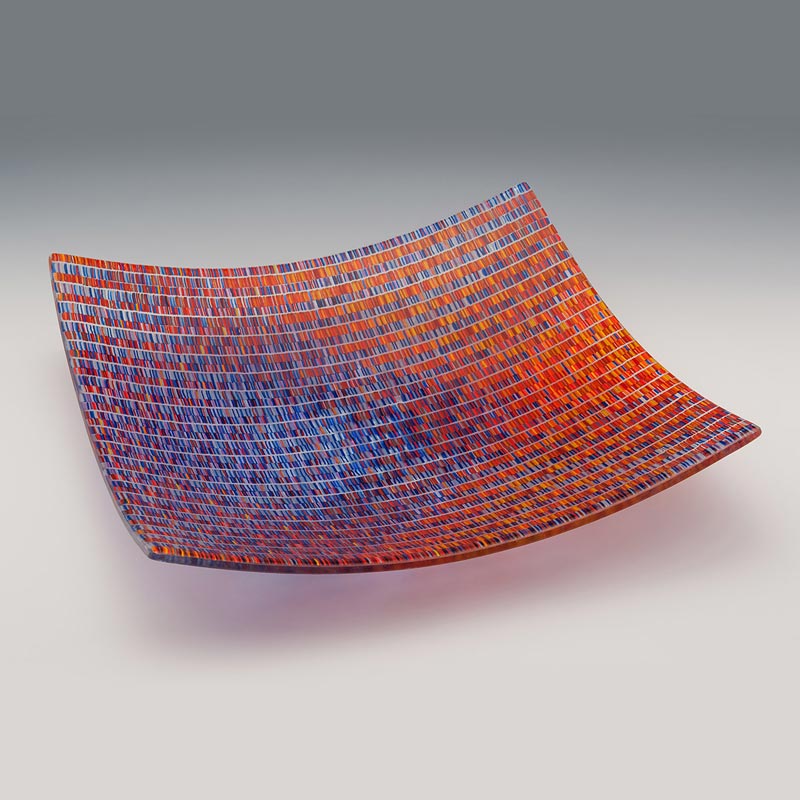
The Tapestry technique is painstaking. The result resembles woven fabric, with all the complexity of textile design translated into permanent, luminous form.
“Inspired by hand-woven fabrics, pieces in the Tapestry series are composed of linear patterns of glass strands creating intricate fiber-like textures,” Parrish explains. What started as grain field observations has evolved into works that make you want to reach out and touch something that looks woven but is actually solid glass. Light moves through transparent sections while opaque elements create rhythm and emphasis.
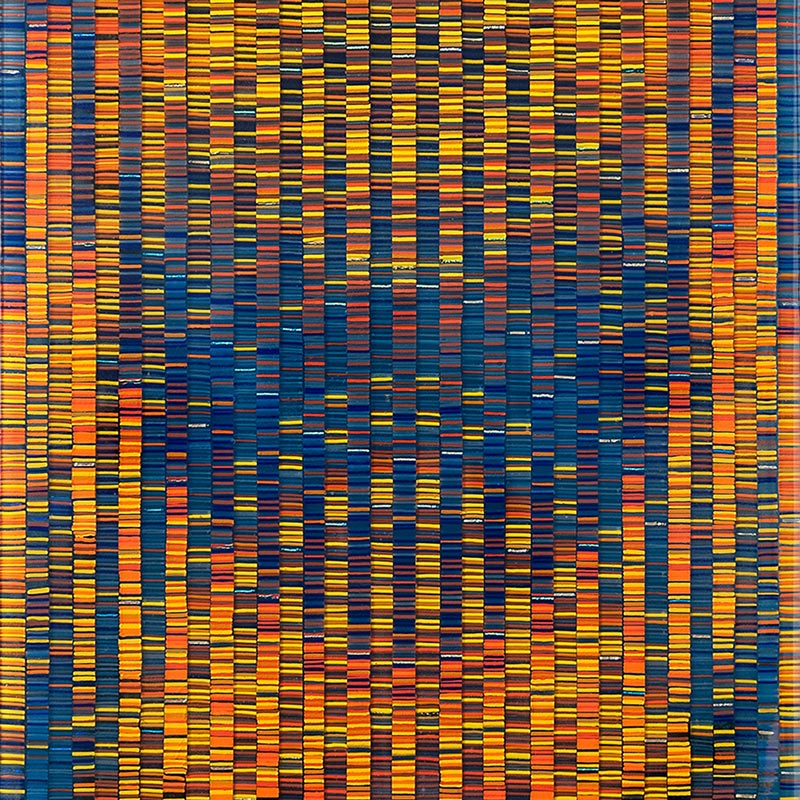
His Mapping series draws even more directly from his roots in the Intermountain West. The thick panels comprise multiple layers of transparent and opaque glass, as well as glass powders, which are kiln-formed to create surface relief and texture. The surfaces, with their earthier feel, encourage viewers to relate to them as paintings rather than traditional glasswork.
The Rockwell Museum in Corning, New York, acquired one of his Mapping pieces for its permanent collection, recognizing how the work provides a bird’s-eye view of landscape informed by aerial photography, where fields, rivers, and crop irrigation patterns are preserved as recognizable components while being presented in an altered spatial context.
“It’s really important to me to be both a maker and a teacher.”
Recognition and Evolution
Over the course of more than 20 years as a professional artist, Parrish has built an impressive resume. His work was selected for the Corning Museum of Glass’s New Glass Review 27 and 38. He earned the American Craft Council Award of Achievement in 2003 and has been featured in exhibitions from Denmark’s Glasmuseet Ebeltoft to California’s Bullseye Resource Center.
Beyond gallery work, Parrish has created significant architectural installations, including windows in the chapel of the new Children’s Hospital in Denver and “Imagine,” colorful waves of glass over the circulation desk at the Bozeman Public Library.
But perhaps most impressive is his willingness to continually refine and improve his own techniques. Two years ago, he began experimenting with flattening glass, reducing its thickness from 9mm to 2mm, using extreme heat and pressure in the fusing process. The resulting Feather Plates series demonstrates what happens when an artist refuses to simply repeat past successes.
Teaching Philosophy
Parrish’s Tapestry workshops explore several approaches to pattern making, beginning with inspiration from fiber and fabric (weaving, tapestry, bargello quilting, basketry), nature (plants, water), and geometry (grids, lines, circles). He discusses elements of color and design theory, including principles such as balance, symmetry and asymmetry, emphasis, and repetition, along with color relationships based on the color wheel.
Beyond technical instruction, Parrish teaches students to see differently, to recognize pattern and color relationships, and to understand how design elements create meaning and evoke emotional responses.
What to Expect at Handwork Week
“Tapestry Through the Looking Glass” offers an intensive immersion into Parrish’s methods. Over five days, students will learn the full range of Tapestry techniques, including on-edge assembly, cutting and reassembling, multiple firings, slumping, and cold working. The goal isn’t to copy Parrish’s aesthetic but to understand the principles well enough to develop personal variations.
The class requires prior experience with both glass cutting (particularly strip cutting at 4mm thickness) and kiln forming. Whether you’re new to Tapestry, have taken a class before, or purchased Parrish’s Bullseye Master Class video, the intensive format allows for deep exploration that isn’t possible in shorter workshops. All materials are included, and students will work with Bullseye Glass throughout the week.
Connection to Place
Parrish’s participation in Handwork Week 2026 connects his Montana practice to a national celebration. As part of BARN’s contribution to Handwork: Celebrating American Craft 2026, the workshop celebrates both traditional techniques and contemporary innovation.
His work embodies exactly what the Handwork initiative honors: craft rooted in specific places and traditions, requiring patient mastery of complex processes, and transforming functional techniques into artistic expressions that emerge from specific American landscapes and experiences.
For students coming to Bainbridge Island for Handwork Week, learning from Parrish offers an opportunity to understand how an artist builds a sustainable practice that balances making and teaching, how architectural training can inform studio work, and how patient observation of the everyday world can become the foundation for a lifetime of creative exploration.
Registration Details
“Tapestry Through the Looking Glass” runs April 27-May 1, 2026, 9 AM – 4 PM daily at BARN’s Glass Arts Studio. Cost: $1380 for members, $1,510 for guests (includes all materials). The workshop is part of BARN’s Handwork Week, celebrating American craft alongside the national Handwork 2026 initiative.
This intensive workshop will transform how you approach pattern, color, and composition in glass. You’ll leave with both finished pieces and the technical foundation to continue developing this luminous technique in your own practice.

Follow Us