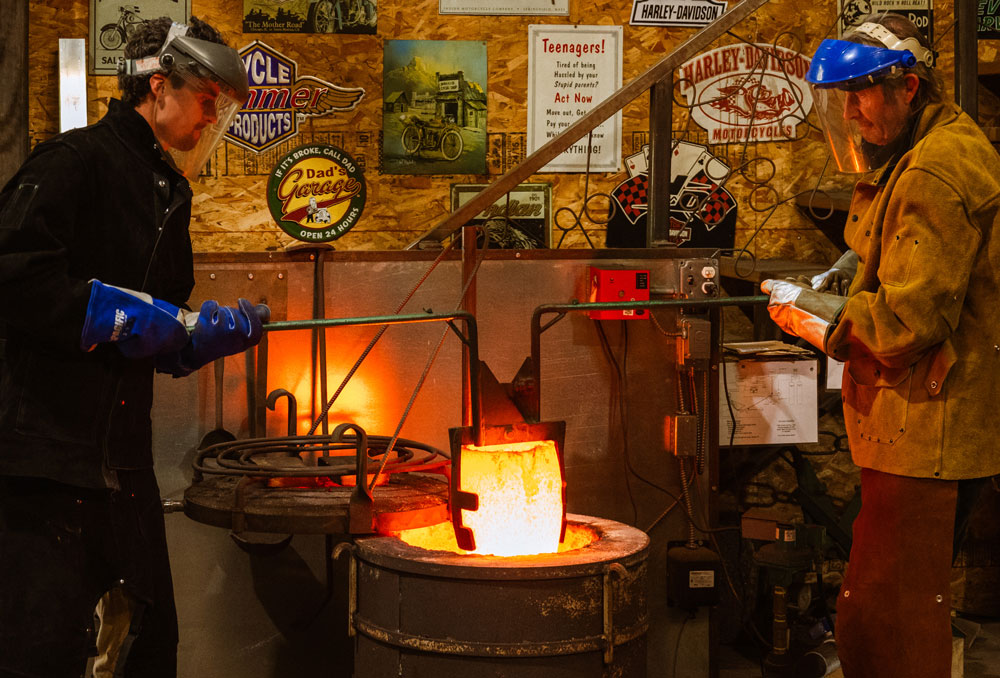
Monkey Wrench Fabrication on Wardwell Avenue is adorned with vintage signs and found metal objects, a fitting detail for a craft that has transformed human civilization for over 5,000 years.
During Handwork Week 2026, this off-the-grid workshop will serve as the backdrop for an intensive five-day journey into bronze casting, led by three masters who bring more than a century of combined expertise to the crucible.
The Cowboy Who Found His Calling
Jeff Oens didn’t start out dreaming of bronze. Growing up on a Montana farm surrounded by horses and cattle, his father wanted him to be a professional bull rider. Instead, Oens became a pickup man—the cowboy who rides in to rescue rodeo competitors after their eight-second rides. He worked in the family business, which traveled to rodeos each summer to train cowboys in the art of bronc riding.
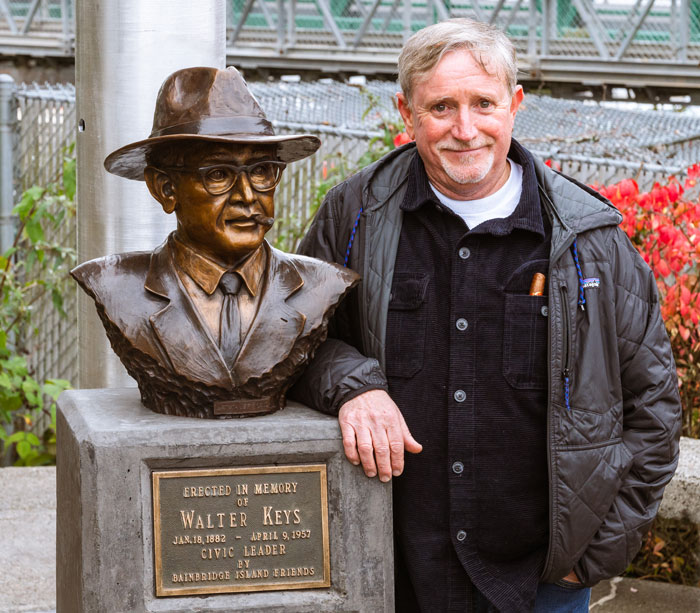
But after high school, Oens taught himself pen and ink drawing, then worked in taxidermy, where he learned the fine details that make his wildlife sculptures so vivid and lifelike. Oens owned a foundry in Tacoma, but got tired of working on other people’s artwork. Today, he’s recognized as one of the Pacific Northwest’s most accomplished bronze sculptors, with works exhibited from Hawaii to Ontario. His nearly life-size moose remains his signature piece. His sculptures populate prominent collections and private estates. Many of Oens’ sculptures can be seen around the Three Tree Lane industrial park near BARN.
The Alchemist Who Never Left the Fire
Mario Oblak built his career around one consuming passion: the transformation of solid metal into liquid and back into permanent form. With a BFA from the University of Washington and an MFA in sculpture from Rhode Island School of Design, Oblak has dedicated himself to foundry work.
“Creating, designing, and building in different materials and mediums is a joy, but working in liquid metal is ‘it’ for him,” reads his instructor bio. “Mario feels ‘casting is a magical process that requires patience, skill, labor, and teamwork, with the results both satisfying and permanent.’ By sharing his knowledge and experience, Mario wants to help others explore, learn, and develop skills so they can see their ideas come to life.”
The Engineer Who Came Home
Frank Wurden represents a different kind of creative journey. With a BS in electrical engineering from the University of Washington, but always taking art classes for his humanities, he went on to earn a BFA degree with an emphasis in life drawing, sculpting, and foundry art. His foundry training included work with green sand, CO2 sand casting, investment casting, and ceramic shell casting. He learned to create patterns from clay, foam, wood, and wax, and to cast in aluminum, bronze, and stainless steel.
After years away from casting, Wurden has returned to the foundry through his work with BARN. His engineering background adds a valuable dimension to the team, offering systematic thinking, problem-solving precision, and the ability to explain complex processes in clear, logical steps.
What Happens in Five Days
The Handwork in the Foundry workshop moves students through the complete cycle of bronze casting over five intensive days. The project is both practical and elegant: each participant will cast their own bronze bell, complete with hanger and clapper.
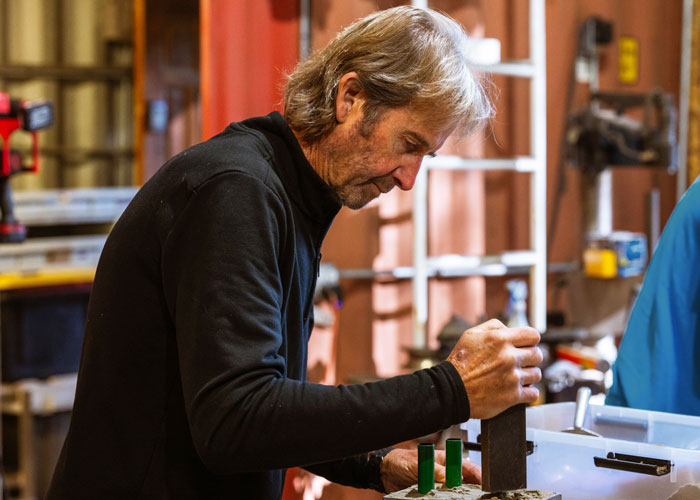
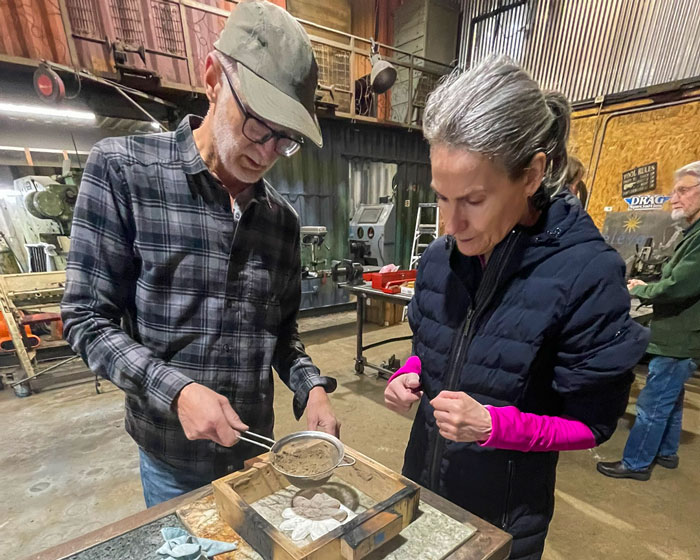
Days one and two focus on mold creation using green sand, an environmentally friendly mixture of fine olivine sand, bentonite clay, and water that holds its shape after the student compacts it around their pattern. .This creates the mold in which molten bronze—heated to over 2,000 degrees and glowing a beautiful orange-red—will be poured. The moment of the pour demands complete focus: the weight of the crucible, the intense radiant heat, the way liquid metal flows like honey made of light.
When students break their “cooled” castings from the molds, they’ll encounter bronze in its raw state—still quite hot, marked by the texture of sand, showing exactly how metal moved through the channels they created. It’s a revelation: what was molten has become solid, what was potential has become form.
Take a look inside BARN’s Foundry program.
Days three and four shift to a focus on finishing. Students learn how to remove gates and sprues, then grind, texture, and polish the castings to achieve desired finishes. A media-blast cabinet may be used for texturing, and blemishes can be filled using a TIG (tungsten inert gas) welder under the team’s guidance. All three castings require machining work. Students will use specially designed jigs to securely hold parts, allowing for precise location, drilling, and chamfering of holes.
By day five, students leave with something extraordinary—a bronze bell they cast with their own hands, its surface bearing the marks of their finishing choices, ready to ring with a tone that’s uniquely theirs. It’s the kind of making that stays with you: the heat, the weight, the knowledge that you’ve worked with one of humanity’s oldest technologies and made something that will outlast you.
The workshop is part of Handwork Week 2026, BARN’s contribution to the national Handwork: Celebrating American Craft 2026 initiative, which brings together more than 200 organizations nationwide to honor the role of handwork in American culture.
Registration Details
“Handwork in the Foundry: Cast Bronze Bell” runs April 27-May 1, 2026, at BARN Welding Studio and offsite at 9392 Wardwell Ave. N.E., Bainbridge Island. Cost: $645 for members, $710 for guests (includes all materials). The workshop is part of BARN’s Handwork Week, celebrating American craft alongside the national Handwork 2026 initiative.
This class will guide you through the process of casting a bronze bell, hanger, and bell clapper. You’ll work with master bronze sculptor Jeff Oens and his team to cast your own bell.

Follow Us