

When University of Washington landscape architecture professor Daniel Winterbottom started wandering the streets of Seattle during the pandemic lockdown, sketchbook in hand, he wasn’t planning to create award-winning reportage. He was simply seeking relief from isolation, a way to connect with the world beyond his four walls.
What emerged from those walks became “The Shifting Landscapes of Despair, Hope, Survival and Persistence”—a powerful documentation of Seattle’s changing urban landscape that earned Winterbottom one of only four Urban Sketchers Reportage Grants awarded globally in 2021.
Now, this acclaimed artist and educator will share his approach to observation and documentation during Handwork Week 2026 at BARN, part of the national Handwork 2026: Celebrating American Craft initiative. His five-day intensive workshop, “Curious and Fearless: Sketching the Story,” runs April 27-May 1, with registration now open at bainbridgebarn.org/handwork.
“Sketching has expanded my curiosity, brought me into spaces I never would have discovered, and increased my connection to place, community, and nature.”
Art as Witness
Winterbottom’s path to urban sketching has been anything but conventional. With a Bachelor of Fine Arts from Tufts University and a Master of Landscape Architecture from Harvard’s Graduate School of Design, he brings both artistic sensibility and design rigor to his work. As a Fellow of the American Society of Landscape Architects (FASLA) and founder of Winterbottom Design Inc., his professional focus has long centered on healing and restorative gardens—designing therapeutic spaces for cancer patients, creating gardens in women’s prisons, and building safe play areas for children living near Guatemala’s largest garbage dump.
But it’s his work as an urban sketcher that reveals another dimension of his practice: art as social witness.
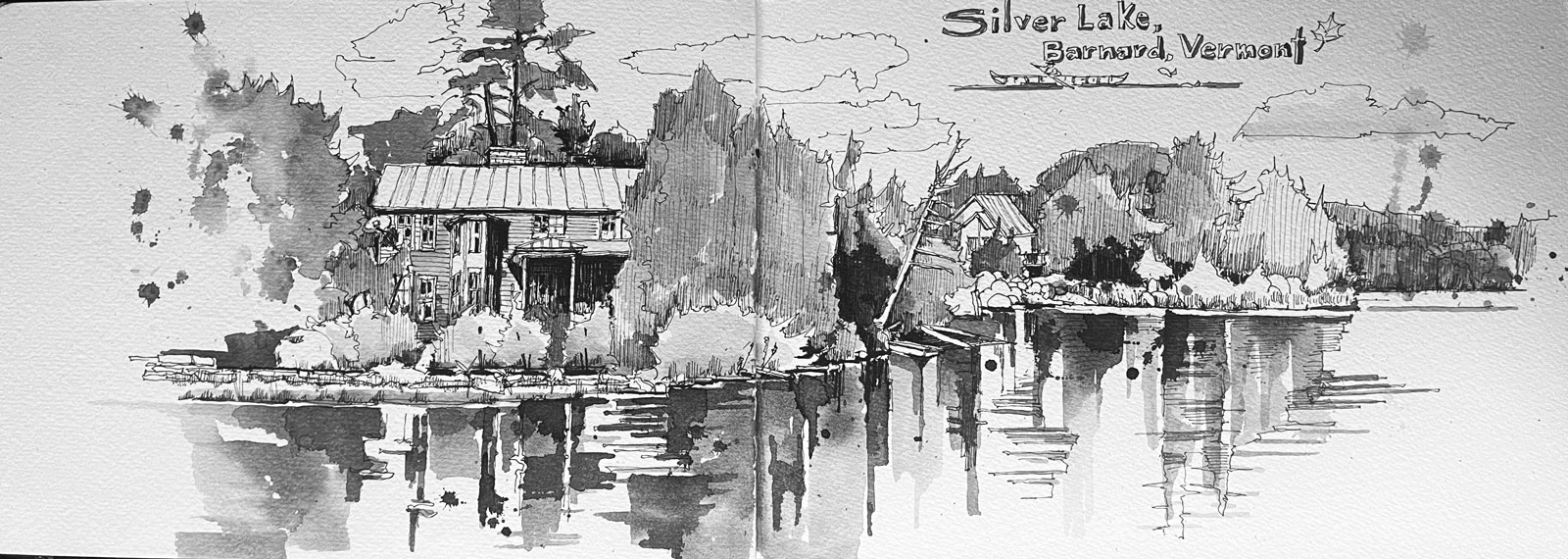
“Seeing the world anew every time I wander about a place with sketchbook in hand,” is what inspires him, Winterbottom explains. “Sketching has expanded my curiosity, brought me into spaces I never would have discovered, and increased my connection to place, community, and nature.”
His pandemic-era sketches documented Seattle’s shuttered businesses and empty streets, as well as tent encampments carved into freeway medians, tucked under bridges, and occupying parking spaces. The work is remarkable for what it shows and what it deliberately omits: the detailed, sensitive renderings rarely include people, respecting the privacy and dignity of those experiencing homelessness while creating what Winterbottom calls “evidence that it is real, and that we as a society have, in part, turned away.”
From Documentation to Advocacy
“For me, art is not benign,” Winterbottom says. “It can be a considered point of view that offers an insight and a new way of seeing something that may have previously been ignored or dismissed.”
This philosophy is consistently reflected throughout his diverse body of work. Current projects include documenting the disappearing landscapes of American agriculture—barns, farms, and factories that are vanishing from the rural landscape. Another ongoing series, “The Last One Standing,” captures the heroic holdouts: single bungalows surrounded by high-density development, their owners refusing to leave as their neighborhoods transform around them.
His work documenting casitas—vernacular Puerto Rican gardens in New York City—was exhibited at the Museo Del Barrio. At the same time, his sketches have appeared in publications ranging from Landscape Architecture Magazine to The New York Times. He’s filled sketchbooks across continents, always finding subjects that reveal both universal human experiences and local nuances.
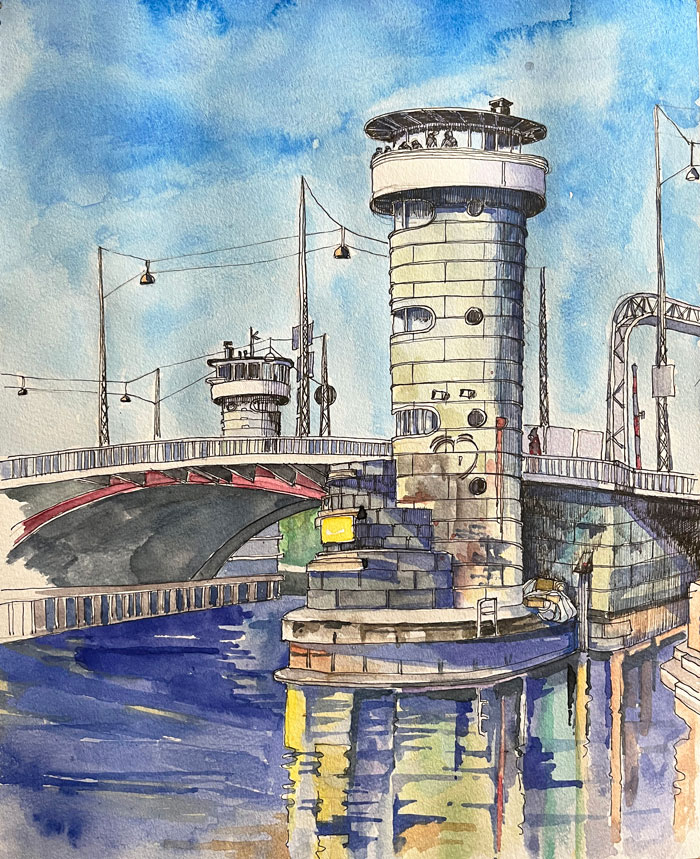
As a featured artist at Sketcher Fest Edmonds and a regular contributor to the Urban Sketchers community, Winterbottom has become known for his energetic pen-and-ink work, often enhanced with watercolor washes. His style ranges from realistic to impressionistic, always grounded in direct observation and field work.
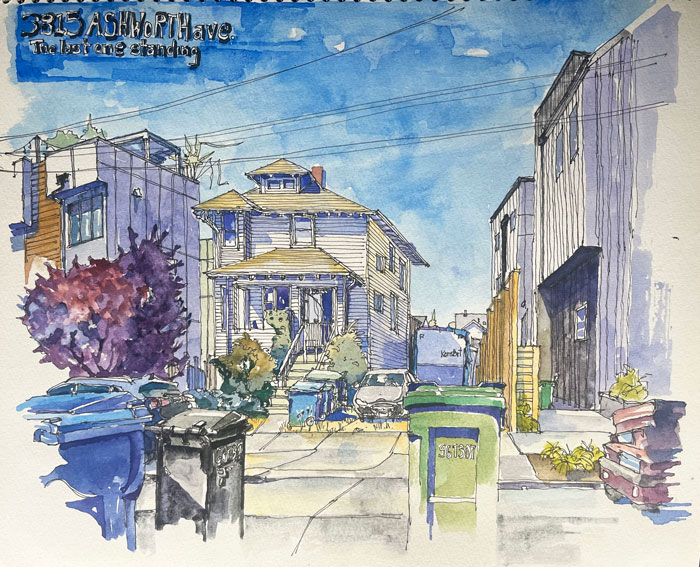
From The Last One Standing by Daniel Winterbottom
“An intensive offers the opportunity to build upon the experiences that have preceded each session, to refine techniques and explore them to their fullest.”
The Five-Day Intensive Experience
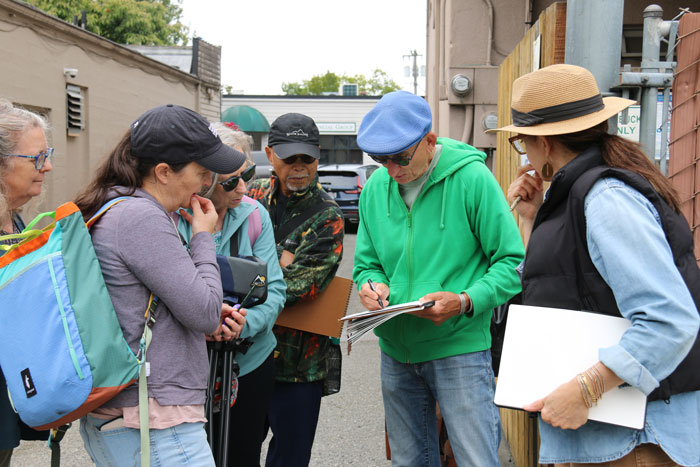
Winterbottom’s workshop, “Curious and Fearless: Sketching the Story,” focuses on field sketching as both a form of reportage and a means of skill development. The curriculum balances lectures and demonstrations with hands-on practice, incorporating both outdoor fieldwork and studio time for refining techniques.
What makes the workshop particularly accessible is Winterbottom’s belief that craft and observation are skills anyone can develop, and that style is deeply personal. The workshop is open to all abilities and training levels.
The five-day format allows something shorter workshops cannot: building upon each day’s experiences, refining techniques without the pressure of a single-day session, and taking creative risks in a supportive environment. “Through sketching we hone the skill of observation, of listening to your senses, of observing phenomena and then learning how to express it,” Winterbottom explains. “An intensive offers the opportunity to build upon the experiences that have preceded each session, to refine techniques and explore them to their fullest.”
Craft as Counterpoint
Winterbottom’s participation in Handwork Week reflects his deep conviction about the importance of handmade work in an increasingly digital age. “The celebration of craft and art is critical in these times of technology and AI,” he notes, calling it “an honor” to participate in this international honoring of traditional skills.
“As gaming and AI become more of the common vernacular, the skills of the craftsperson who uses their hands, eyes, and brains to create beauty and meaning will offer a touchstone,” he observes. For him, the choice to sketch on location – standing in the weather, adapting to changing light, engaging directly with the scene – is itself a form of resistance to the mediated, screen-based experience that dominates contemporary life.
Beyond Technique
What excites Winterbottom most about joining artists from across the country for Handwork Week at BARN is the energy of creative exchange. “I love the international flavor as art can bring people together and celebrate creativity and open exchange,” he says. “The energy is always a delight to be around!”
Beyond teaching specific technical skills, Winterbottom aims to influence how participants approach their creative practice. His work demonstrates that sketching can be more than refinement of technique, but about developing a deeper way of seeing, a practice of paying attention, and a means of bearing witness to the world.
Registration is now open for “Curious and Fearless: Sketching the Story” with Daniel Winterbottom as part of Handwork Week 2026 at BARN, April 27-May 1. Details and registration at bainbridgebarn.org/handwork.

Follow Us