
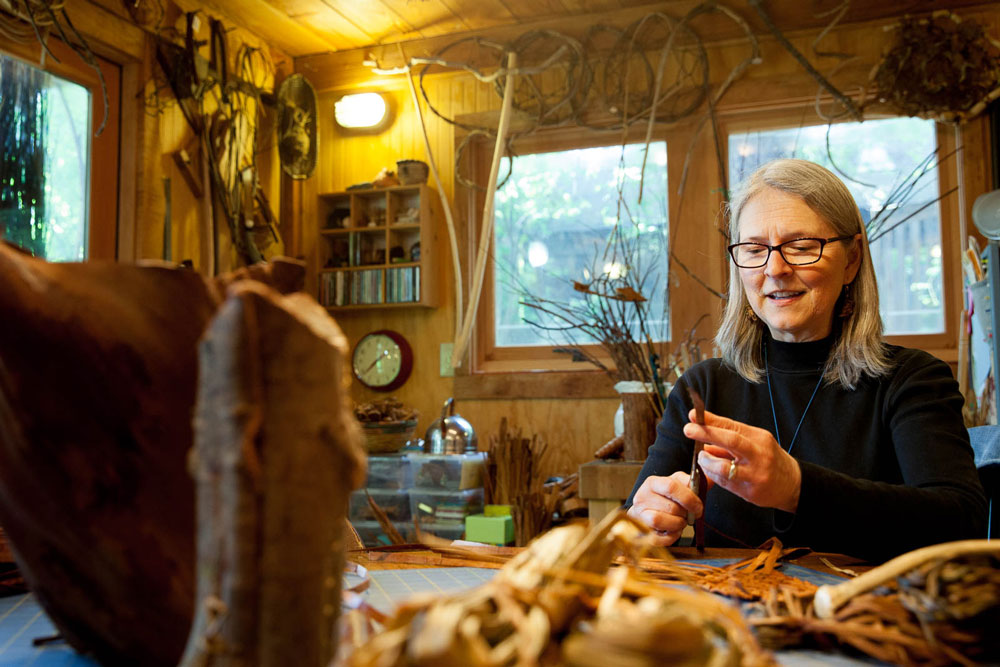
Forty years ago, Melinda West sat on a Pacific Northwest beach watching her young sons play. Nearby, someone had discarded a pile of willow trimmings. On impulse, she began weaving them together. The result, she recalls, “looked wildly made like a crazy bird’s nest”—but that spontaneous moment of creation on a beautiful shoreline kindled a passion that would define the next four decades of her life.
Today, West is one of the Pacific Northwest’s most accomplished plant fiber artists, with award-winning work in public and private collections, exhibitions spanning from London to Seattle, and a teaching legacy that extends to prestigious institutions such as the Seattle Art Museum. This spring, she brings her deep knowledge of sustainable gathering and Coast Salish weaving traditions to Handwork Week 2026 at BARN, where her five-day intensive workshop, “Weaving Nature: Seasonal Plants for Basketmaking,” runs from April 27 to May 1. Registration is now open at bainbridgebarn.org/handwork2026.
“It is more important than ever to kindle in others a relationship to nature and to be part of a community.”
A Journey Rooted in Place
West’s path to basketry began with a profound moment of connection. When she and her family moved to an old cottage in Indianola, Wash. — built on traditional Suquamish land — she discovered a small Coast Salish basket left on a shelf. As she cradled it, questions flooded her mind: How did the weaver construct this basket? Who did they learn from? Why was it made?
“At that very point in my life,” West reflects, “the physical act of touching and holding this small old basket gently guided me towards another career.”
West had trained as a pediatric nurse and was born and raised in Seattle. But living on Suquamish territory, she found herself drawn to understanding the traditional fiber technologies practiced by Coast Salish peoples. She sought out teachers, the foremost being her neighbor and friend Ed Carriere of the Suquamish Tribe, with whom she has studied and collaborated for decades.
Learning From the Land and Its Peoples
Over the course of her practice, West has studied with numerous Native and non-Native weavers and artists, absorbing techniques and philosophies that honor both the plants and the cultures that developed these practices. Her teachers have included Lummi plant fiber and Salish wool weavers Fran and Bill James, master woodcarver Duane Pasco, South Carolina Lowland Gullah Geechee sweetgrass basket maker Lynette Youson, and many others who generously shared their knowledge.
This commitment to learning from diverse traditions has shaped West’s approach to both making and teaching. She established BARN’s basketry program from 2014 to 2019, laying the foundation for what has become a vibrant fiber arts community. She has taught at Olympic College, North Cascades Institute, Heronswood Nursery, Coupeville Arts Center, and for numerous weaving guilds throughout the Pacific Northwest. For nearly two decades, West served as Artist-in-Residence at IslandWood, teaching plant fiber weaving to students with wildly diverse backgrounds.
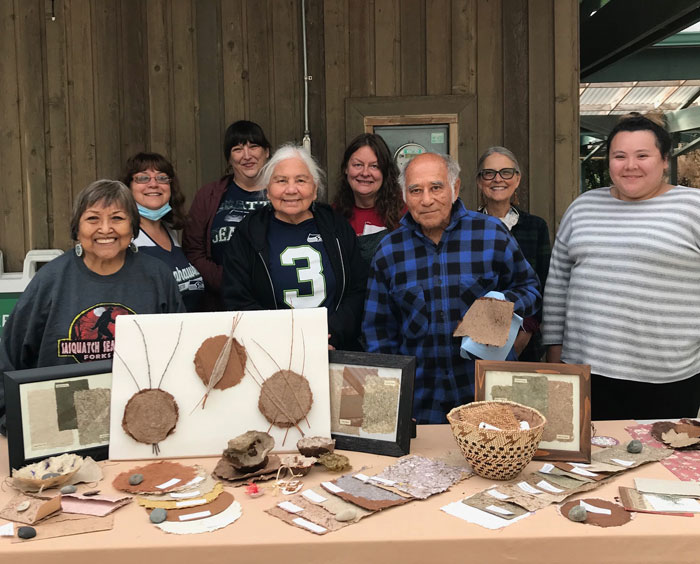
Second from right: Melinda West. Third from right: Ed Carriere
“Each year I’ve met populations of young people,” she notes, “and I have learned important lessons from them each year. My measurement of success is to see each student create something they didn’t know they could make.”
The Art of Reciprocity
What distinguishes West’s practice is her deep commitment to sustainable and respectful gathering, rooted in Coast Salish principles of reciprocity with the natural world. “Gather with respect. Take only what you can use. Prune to encourage growth,” she writes, principles that guide every aspect of her work.
Her artistic practice has become a doorway into the cultural and ecological knowledge of place. She recycles bark from trees being cut down, selectively prunes to promote plant health, and replants at every opportunity. This isn’t just environmental stewardship, it’s a relationship of partnership with plant communities that Coast Salish peoples have maintained since time immemorial.
What Inspires Her
When asked what inspires her work, West’s answer reveals the breadth of her attention: “Nature, children playing, love, wondering, discovery, beavers, spiders, and birds.”
It’s this sense of wonder and observation that infuses her teaching. Her work ranges from traditional ribbed basketry using materials harvested from Pacific Northwest landscapes — barks, grasses, leaves, vines, roots, and limbs — to contemporary art pieces that push the boundaries of plant fiber work. She has exhibited at venues including London Craft Week, the Heronswood Garden House, and Bainbridge Arts and Crafts Gallery, with her work featured in books and magazines.
The Five-Day Intensive Experience
West’s Handwork Week workshop addresses crucial questions facing contemporary basketmakers: With native forests, wetlands, and open spaces greatly diminished, where can we sustainably gather plant fiber materials today? How do we conscientiously prepare, store, and use plant materials? Can we positively impact the landscapes within our reach?
The workshop offers an intensive exploration of ribbed/frame basketry, with participants learning to identify, harvest, process, store, prepare, and weave with a variety of native, introduced, and invasive plant fibers. Each day builds toward completing three types of ribbed/frame baskets, with techniques including ribbed frame construction and shaping, making cordage from leaves and bast fibers, limb bending for hoops and frames, pulling cedar bark from freshly cut trees, peeling willow and dogwood bark, and splitting limbs and roots to make weavers.

“I hope to offer new perspectives to students on ways to connect and think about plant communities,” West explains. “A five-day intensive makes it possible to spend time going deeper into the lessons plants have to offer; the cultures that have held and practiced this transfer of knowledge through their plant craft; and the artistic expression that can come through the practice of plant-fiber technologies.”
The extended format allows participants to move beyond basic technique into understanding the deeper cultural and ecological context. Students will work with materials that connect directly to Coast Salish traditions. The same plants have provided for physical, intellectual, and spiritual life in the Pacific Northwest since time long past.
Craft as Community and Healing
For West, the importance of handmade work extends far beyond the objects created. “It is more important than ever to kindle in others a relationship to nature and to be part of a community,” she emphasizes. “The value of being outside, working with plants, learning their stories, and then learning to make things with them is empowering.”
The act of making can be healing, she notes — often serving as an antidote to stress, providing time for reflection and processing strong emotions. “It gives opportunity for expression, experimentation, and discovery. Handmade work is the visible product of a healthy community.”
This philosophy aligns perfectly with BARN’s mission and the broader goals of Handwork 2026: celebrating traditional knowledge while building contemporary community through craft. What excites West most about joining artists from across the country at BARN is the opportunity for connection: “I love to hear the stories of other makers who are passionate about learning and building community through sharing the craft skills they know.”

Looking Forward
West’s work represents something increasingly rare: a sustained, multi-decade commitment to learning, practicing, and teaching a traditional craft with deep cultural roots.
Participants in her Handwork Week workshop will emerge with beautiful organic baskets. More importantly, they’ll be empowered to identify functional plant fibers for future projects and inspired to gather materials in safe, ethical, and sustainable ways. They’ll understand not just how to weave, but why — connecting technique to the cultural traditions and ecological wisdom that make this craft meaningful.
As West prepares for Handwork Week, she carries forward the lessons of 40 years: that craft connects us to place, to each other, and to generations of knowledge keepers who developed these practices. A pile of willow trimmings on a beach can change a life. The act of making with natural materials is not nostalgic, but vital and very much alive.
Registration is now open for “Weaving Nature: Seasonal Plants for Basketmaking” with Melinda West as part of Handwork Week 2026 at BARN. The workshop is open to all skill levels, although a certain level of hand strength is essential, and participants should be comfortable working with various plant materials. This special offering is part of Handwork Week 2026, a celebration of American craft in partnership with PBS’s Craft in America and the Smithsonian’s Renwick Gallery. Full details and registration can be found at bainbridgebarn.org/handwork2026.
Cover image of Melinda West in her studio by Claire Dibble.
Follow Us